

Which Political Party Had The Largest Number Of Registered Voters In 2012?

Westminster Palace, where these parties hope to sit down.
10 political parties are represented in the Business firm of Commons of the United Kingdom, with a further two formerly represented in the European Parliament and quite a few more than with representation at a local level. Equally elections to the Parliament of the United Kingdom are operated under a 'kickoff past the post system' and elections to the Parliament of the European Union were operated under a proportional representation organization (PR), pocket-size parties who have support spread throughout the land, just non plenty concentrated support to win an unabridged constituency, can frequently discover representation in the EU. For this reason, the United Kingdom Independence Political party and the British National Party had MEPs but no MPs. Likewise, the Scottish and Welsh Parliaments have their own class of PR, and the Northern Irish Assembly is designed to reflect the complexity of NI viewpoints.
There are five legislative bodies in the United Kingdom aslope the European Parliament which are made up of officials elected past residents of the United Kingdom who hold citizenship to the Britain, the Republic of Republic of ireland, or whatsoever Republic nation. The House of Commons, located in London, England, is the primary governing body in the United kingdom responsible for creating and upholding national law, except for areas devolved to the constituent nations, and with the power to change and repeal those brought into upshot by its devolved counterparts. Elections to the House of Commons take place once every five years nether a first-past-the-post system. Members of the Business firm of Lords are unelected; rather, they are made Lords and Ladies for their services, or for otherwise being incredibly rich.
Members of the Scottish Parliament, the National Assembly for Wales, the London Associates and the Northern Republic of ireland Assembly can be voted for by the aforementioned citizens living within jurisdiction of the legislative trunk concerned, each devolved body using a variation of the proportional representation organization. Elections to the devolved Parliament and Assemblies take place once every four years.
Contents
- ane Major parties
- one.1 Conservative Party
- i.2 Labour Party
- 1.3 Liberal Democrats
- ii Modest parties
- 2.1 Green Party of England and Wales
- 2.2 Reform Britain (formerly the Brexit Party)
- 3 Really small-scale parties
- 3.1 United Kingdom Independence Party
- iii.ii British National Party
- 3.3 Christian Peoples Alliance
- three.iv Christian Party
- 3.5 Liberal Party
- 3.6 Socialist Labour Party
- three.7 Official Monster Raving Loony Political party
- three.8 National Front
- 3.ix Veritas
- three.ten National Health Action Party
- 3.11 Contained Network
- three.12 We Demand a Referendum
- iii.13 Referendum Political party
- 4 Scottish parties
- 4.i Scottish National Party
- 4.two Scottish Green Party
- 4.3 Scottish Socialist Party
- iv.four Scottish Unionist Political party
- 4.5 Alba Party
- 5 Welsh parties
- 5.1 Plaid Cymru
- 6 Northern Irish parties
- 6.1 Democratic Unionist Party
- vi.2 Sinn Féin
- 6.3 Ulster Unionist Political party
- 6.4 Social Democratic and Labour Political party
- 6.5 Alliance Political party
- half dozen.6 Traditional Unionist Vocalism
- 6.7 The Workers Party & the Irish Republic Socialist Party (ISRP)
- 6.8 Dark-green Party Northern Ireland
- vii English parties
- seven.1 English Democrats
- vii.ii Mebyon Kernow
- vii.3 Yorkshire Political party
- viii Former parties
- 9 Meet also
- 10 References
Major parties [edit]
Conservative Party [edit]

- Members of the House of Commons: 365[one]
- Members of the Firm of Lords: 242
- Scottish Parliament: 31
- Welsh Assembly: eleven
The Conservative Party, officially the "Conservative & Unionist Party", and commonly known as "The Tory Political party" or "the Tories" is one of the two largest political parties in the United kingdom. Since World War Two, every Prime Minister has come from the Conservative Party or the Labour Party. Generally standing for lower tax, a smaller state and lower welfare, the Conservative Party is the traditional right-wing political party in the Great britain. Given that the Conservative Party vehemently opposed almost all of Blair's early manifesto promises and that the political party leadership has now accepted many of them (minimum wage, Bank of England independence, civil partnerships, various anti-discrimination laws), the political party tin can be quite fractured at times, with a significant minority being very much opposed to membership of the European Spousal relationship. Notable figures include Winston Churchill, Margaret Thatcher, David Cameron, Theresa May, and Boris Johnson.
Labour Party [edit]

Labour Party leaders in 2017.
- Members of the House of Commons: 202
- Members of the House of Lords: 183
- Scottish Parliament: 23
- Welsh Associates: 29
The Labour Party is the other main party. Founded as a socialist political party, the Labour Party had a huge function in the creation of the Welfare State and the National Wellness Service. Afterward nearly ii decades of Bourgeois rule, the Labour Party moved much closer to the centre, stepping away from its socialist roots and becoming a "big tent" centrist party. This step clearly made them an electable opposition, as they won in a massive landslide in 1997, but it'southward at present somewhat unclear exactly what they stand for other than "we're nicer and less right-fly than those bastard Tories". Former leader Jeremy Corbyn, while restoring self-conventionalities among the party true-blue, appeared less popular among the general public - and they're the ones who decide elections. Notable Labour figures include Clement Attlee, Tony Blair, Gordon Brownish, Jeremy Corbyn, Keir Starmer and a wealth of glory supporters.
Liberal Democrats [edit]

The Liberal Democrats march to remind the public that they still exist.
- Members of the House of Eatables: 11
- Members of the Business firm of Lords: 94
- Scottish Parliament: five
- Welsh Assembly: one
The Liberal Democrats, oftentimes known every bit the Lib Dems, were traditionally the third political party in the United Kingdom simply severely reduced their MPs and popular vote in the 2015 General Election. Their predecessors the Liberal Political party declined severely before Earth State of war Two as the Labour Party took over as the main left-wing political party. The Liberals were non a potent serious force in British politics, but they merged with the Social Democrat Political party (a splinter group of the Labour Political party) in 1988 to form the Liberal Democrats. The Liberal Democrats were hugely popular among students and take often been the get-to 'protest vote' of the center classes. They also maintain traditional support bases among the elderly, and in areas such as the West Land. Advocating progressive taxation, nuclear disarmament and electoral reform, the Liberal Democrats saw a big surge in back up every bit they were the only major party to seriously oppose the Iraq State of war. In a weird twist, they formed a coalition regime with the Conservative Party in 2010, with the idea of 'taking the edge' off the Tory spending cuts and making them fairer for the poor. Their complete failure to do this severely damaged their support among students, public sector workers, all those afflicted by the budget cuts; they lost them a lot of support at local government level, losing them control of many local councils. in the 2015 election they lost nearly two-thirds of their back up, and lost nigh 50 MPs. In 2019, they gained popularity for their stiff anti-Brexit stance. Notable figures include Nick Clegg, Charles Kennedy (the Great britain'south favourite alcoholic), Vince Cable (leader from 2017 - 2019), Jo Swinson (leader from July - December 2019), the baroque Lembit Opik and sometime leader Paddy Ashdown, who finer ran  Bosnia for a four yr period.
Minor parties [edit]
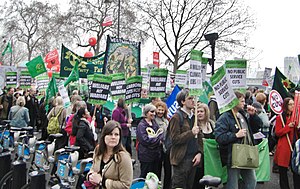
Green Political party rally in 2011.
Green Party of England and Wales [edit]
- Members of the House of Commons: 1
- Members of the House of Lords: 1
The Greenish Party are a left-fly political party who advocate environmentalism, pacifism, eco-socialism and no-growth economic science. They as well take a very liberal arroyo to gay rights, electoral reform, drug policy and brute rights and a not so liberal mental attitude towards freedom of expression, faith and government control. Their roots as a political political party get back to various campaign groups from the 1970s, back when it was known as the Ecology Party. From the 1990s onwards they began to achieve some limited electoral success at local authorities elections in a scattering of England'southward middle class university towns (Oxford, Norwich, Brighton), and MEP seats in European elections.
Tightening themselves up somewhat (including booting out loonies like David Icke, and decided at last to have a political party leader, rather than simply a governing commission), they finally secured their commencement outset seat in the House of Eatables in the full general election of 2010, when political party leader Caroline Lucas took Brighton Pavillion. This was followed by the Greens forming a minority administration running Brighton & Hove City Quango in 2011. Lucas stood down as leader in 2012, in an endeavor to heave the profile of other colleagues. The political party is notably more than eurosceptic than nearly all left-fly parties, although they wish to stay in a reformed Europe.[2]
It should exist pointed out that Scotland and Northern Republic of ireland have their own carve up Green Parties (but not Wales). The SGP has enjoyed a more than consistent success than its English sister party.
Reform Uk (formerly the Brexit Party) [edit]
- Welsh Assembly: four
The Brexit Party was established in early 2019, with the majority of the original members coming from UKIP which it has supplanted. From 2019 - 2021 information technology'south leader was Nigel Farage, the former leader of UKIP. The Party's main policy is to leave the European union with a 'hard Brexit' on 31 October. The Brexit Political party performed well in the May 2019 European union Elections, winning 29 of the UK'south 73 seats.
Since Brexit, the party has had to redefine itself and focus on other bug, such as electoral reform and opposition to lockdowns, mask mandates and other COVID-xix restrictions.
Really pocket-sized parties [edit]
United Kingdom Independence Party [edit]
- Members of the House of Eatables: 0

- Members of the Firm of Lords: 0
- Welsh Assembly: 0
UKIP are correct-wing party who take benefitted profoundly from proportional representation, holding over 16% of the UK'southward seats in the European Parliament. The triple whammy of beingness business firm advocates of the UK's withdrawal from the European Union, beingness seen as more right-fly than the Conservative Party and denying climatic change has given them real entreatment on the right-wing of the United kingdom of great britain and northern ireland'southward political spectrum. In the UK'due south general election, they seem to just human action as a spoiler party for the Conservatives. Some sources even seem to think the Tories would hold an overall majority if it weren't for UKIP. However, their strong numbers in many Labour rubber seats pb them to act as something similar towards the Labour party, as many quondam Labour voters take found themselves disaffected towards the political party, mainly due to the social impact of their open door clearing policies. Equally it stands, UKIP is the only 3rd political party to have won elections to the European Parliament, and as a party they came a significant third in the overall popular vote of the Britain's General Election come up 2015. Nevertheless, the First By the Mail electoral arrangement, tied together with some controversial campaign spending from the Bourgeois and Labour parties, led to them simply retaining a single seat gained from a Clacton by-election. Notable figures have included Nigel Farage and Christopher Monckton.

British National Party [edit]
The British National Political party is the product of years of in-fighting, mergers and hissy fits from extreme-right 'politicians' and racists from the United Kingdom (including the National Front end). It had a brief successful menstruation in the first decade of the 21st century when it gained a few dozens seats in local authorities (mainly in areas of racial tension) and two seats in the European Parliament. They declined from this, with nearly councillors losing their seats in 2010 or 2011 and falling from ii to no MEPs after 2014.[three] Advocating an end to international aid and immigration, as well as deportation for recent immigrants, the party has had more than its fair share of controversies. Sickeningly, the party tries to claim Winston Churchill as their ain. The judiciary recently ruled that their 'whites-only' membership policies are illegal. Notable figures include former leader Nick Griffin, whose leadership led them to curt-lived national prominence (earlier he was expelled from the party in 2014), and political party founder the late John Tyndall, an unabashed neo-Nazi who was replaced by Griffin in 1999.[4] The futurity of the BNP includes the words "circling" and "drain." As is typical with such organisations, the BNP is in danger of becoming eclipsed past splitters, in this example in British Freedom and the English Defence League. They chiefly institute themselves eclipsed by the rise of the more moderate Nationalist party, the UK Independence Party.
Christian Peoples Brotherhood [edit]
The Christian Peoples Alliance is a Christian democratic political party in the United Kingdom founded in its present form in 1999. It is the largest openly Christian party in United kingdom of great britain and northern ireland. As it says in information technology'southward latest manifesto released in 2017[five] , the party wants to finish fractional reserve cyberbanking, bit Trident and promote union by giving newly wed couples a £10,000 grant. They are besides against homosexual wedlock and adoption[6].
Christian Party [edit]
Britain'south biggest outpost of Christian wingnuttery.
Liberal Party [edit]
The Liberal Party was formed in 1989 past a grouping of individuals inside the original Liberal Party who disagreed with the merger with the Social Democratic Political party to form the Liberal Democrats. They claim to exist the legal continuation of the old Liberal Party, resulting in them beingness jokingly referred to equally the Continuity Liberal Party. In reality, traditional Liberals from decades ago would struggle to recognise the current party, which includes open Satanists and far-leftists. They have well-nigh two dozen local government councillors, and occasionally beat the LibDems in Parliamentary elections in Liverpool... In fact, their chief political function seems to exist to gain a few Lib Dem votes from the easily bewildered and short-sighted.
The SDP as well has a continuity group still in existence, which is fifty-fifty smaller.
[edit]
Founded by veteran trade unionist Arthur Scargill, the man largely responsible for the 80s coal miners' strike... this lot rejected New Labour's moderation in favour of old-schoolhouse policies. The SLP scores 1-ii% of the vote in places where it stands (chiefly urban areas).
Official Monster Raving Loony Political party [edit]
The Official Monster Raving Loony Political party (OMRLP) are the about prominent joke party in UK politics. The current political party leader is Alan "Howling Laude" Hope. They are the only party to accept put forward a concrete global warming reduction strategy, namely the installation of air conditioning units onto the outside of buildings in society to lower the atmospheric temperature. Their idea of passports for pets managed to get law, somehow... Every bit did their proposed legalisation of commercial radio. (Which volition probably puzzle most American readers.)
National Front [edit]
The ancestor of the BNP, the National Front was once the fourth largest political party in the land, with members elected to a few boondocks councils in the belatedly 1970s. Information technology declined considerably with the rise of the BNP (same policies simply dressed in suits and ties instead of the hooligan'southward favourite "bovver " gear).
The NF tends to exist more of an activist and pressure group than a party, simply all the same enjoys some notoreity. Remember NorseFire from V for Vendetta? Well, in the book they were straight inspired by the NF.
Veritas [edit]
Robert Kilroy-Silk, former Labour Party shadow minister turned daytime TV host and tanning abet, stood under the UKIP banner and so decided he didn't actually like UKIP, he decided to set a party called "Veritas" (Latin for truth). It did even worse, although due to defectors from UKIP, it did have some seats in Brussels and in the London Assembly. Afterward standing cypher candidates in the 2010 full general ballot, they are now mostly forgotten (sadly, cheers to reality TV show I'm a Glory, Go Me Out Of Here, Kilroy-Silk has not been forgotten along with them).
National Wellness Action Party [edit]
National Health Activity Political party (formerly Heath Concern) began as a fringe party with the unmarried issue of reopening their local hospital's casualty unit of measurement. Amazingly their candidate, a local physician , was elected to Parliament in 2001, and kept his seat until 2010. Although still centred on their Kidderminster heartland, their gain of a council seat in a neighbouring county, and having a candidate in the Eastleigh past-election a hundred miles away, suggests this tiny party has ambition.
Contained Network [edit]
The Independent Network was created in 2005 to support and advise independent candidates. It is headed by Martin Bell , a former contained MP. Information technology doesn't accept policies (although it won't support anyone with discriminatory views), and so probably doesn't actually count every bit a party.
We Demand a Referendum [edit]
A single-event political party whose goal is to force a plebiscite on the United kingdom's membership in the EU. Founded by MEP Nikki Sinclaire in 2012, afterward she was expelled from UKIP for refusing to piece of work with other far-right parties in the EFD group.
Plebiscite Political party [edit]
Some other anti-Eu party, dating back to the 1990s, when it was formed by eccentric businessman James Goldsmith. Its celebrity supporters included former That'south Life! presenter Gavin Campbell. After winning 0 seats in the 1997 Full general Election, it changed into a force per unit area group under James's wife Annabel.
Scottish parties [edit]

Chief bedroom of the Scottish Parliament.
Scottish National Party [edit]
- Members of the House of Commons: 47
- Scottish Parliament: 62
The Scottish National Political party is a centre-left political party who advocate Scotland's independence and full membership of the European union. They take 62 of the 129 seats in the Scottish Parliament, forming a minority authorities with the informal support of the Scottish Dark-green Political party. Their biggest electoral achievements were in 2011 winning 69 seats in the Scottish parliament, the just time any political party has won a majority, and winning all but iii Scottish Westminster seats in 2015 (but losing 21 in 2017) thanks to plummeting support for Labour.[7] [8] [9] [10] They abet progressive tax, free higher education, and are massive supporters of the National Health Service. As function of seeking to improve public wellness in Scotland by limiting alcohol consumption, the SNP has as well pushed for minimum pricing for alcohol[11] and some limitations on availability (e.g. at football game[12] stadiums[thirteen]). The party is traditionally very anti-state of war, although it has supported NATO membership since 2012.[fourteen] [fifteen] Notable figures include Alex Salmond and Nicola Sturgeon, respectively the former and current Outset Minister of Scotland. The SNP is the second largest political party in the UK by membership, despite only occupying a small office of the UK.[16]
Scottish Greenish Party [edit]
- Scottish Parliament: 6
Although working closely with the other Green Parties in the United Kingdom, the Scottish Light-green Political party is fully independent and also wants an independent Scotland. The party previously held 7 seats in the Scottish Parliament, and came very close to gaining a seat in the European Parliament. Their co-leader is the first openly bisexual political party leader in the UK.
[edit]
Local government: 0[17]
The SSP had some success in the commencement and 2nd Scottish Parliaments. Its quondam leader was Tommy Sheridan elected, and in the next election in 2003 they returned its best electoral effect with vi people elected into the Scottish Parliament.[eighteen] . Sheridan was later on jailed for lying to court about his visits to swingers clubs and participating in other sexually interesting activities. This split the party and (erstwhile) members spent more time attacking one another than on anything else.
The SSP is what information technology says on the tin. In 2016 they were part of the RISE coalition of left-wing parties but failed to win any seats in the Scottish Parliament.[xix]
Scottish Unionist Political party [edit]
Not to exist confused with the "Scottish Conservative and Unionist Party" (the Tories' official name in Scotland), the SUP is a tiny political party based in West Key Scotland (the Glasgow hinterland). It is substantially an unofficial political wing of the Orange Guild (Protestant supremacists) in Scotland. They stand few candidates, but have managed to survive for a number of years. Most of their political narrative seems to be based effectually Northern Ireland, fifty-fifty the matter of Scottish indepebdence.
Alba Political party [edit]
An SNP splinter group, with some notable members such equally Alex Salmond and Tasmina Ahmed Sheikh, the Alba Party stood in the 2021 Scottish elections and won no seats. Their idea was to "hack" the D'Hondt balloter organization used in Scottish elections and create an independence majority.
Their two main policies were Scottish independence and not-existence-the-SNP. Beyond that it was hard to ascertain anything.
"Alba" is the Gaelic name for Scotland.
Welsh parties [edit]
Plaid Cymru [edit]
- Members of the House of Commons: 4
- Members of the House of Lords: 1
- Welsh Assembly: 10
Plaid Cymru (The Party of Wales in Welsh) is a left to centre-left party which advocates Welsh independence and big efforts to revive the Welsh linguistic communication. They're quite a pro-environmental party, working closely with the Scottish National Party in the European Parliament. Welsh people, on the whole, don't want independence - and support for Welsh independence is significantly less in Wales than the support for Scottish independence in Scotland. This goes part of the way to explaining why they play a much smaller role in devolved government than their Scottish counterparts. Despite this, they were junior partner in a coalition with the Labour party, who concur 26 seats in the Welsh Assembly. Notable figures include former leader Leanne Wood, the only political party leader with the guts to tell Nigel Farage where to get off. To his face up.
Northern Irish gaelic parties [edit]
Since the partitioning of Republic of ireland and creation of Northern Ireland in 1922, Northern Irish politics has remained doggedly arranged on sectarian lines, with 1 set of parties being Unionist (and overwhelmingly Protestant), favouring continuation of the Spousal relationship of Northern Ireland with Great United kingdom of great britain and northern ireland, and the other being Nationalist (and overwhelmingly Catholic) and campaigning for Northern Ireland to leave the Uk and bring together with the Republic of Ireland in a 'United Ireland'.
The mainstream British political parties take mostly declined to field candidates in Northern Ireland. On the ground of their standing on a left wing/correct wing centrality, the Labour party regard the nominally socialist SDLP equally their counterpart, the Conservatives likewise with the Ulster Unionist party, with the Liberals/LibDems paired against the Alliance party. This rather glosses over the Northern Irish gaelic parties' sectarian nature, although since the 1998 Adept Friday Agreement the parties accept been obliged to broaden their scope somewhat from their single-consequence sectarian agendas.
Autonomous Unionist Party [edit]
- Members of the House of Commons: 8
- Members of the Firm of Lords: 4
- Northern Ireland Assembly: 27
The Democratic Unionist Party (or DUP) was founded in the 1970s, by Rev Ian Paisley. It was a split from the mainstream Unionist party. The iconoclastic Paisley had already formed his own church denomination, the Free Presbyterian Church, as a dissever from the Presbyterians. Like his church, the DUP tended to cater for the more fundamentalist, working grade flavour of protestant bigot unionist. Yet post-obit the Expert Friday Agreement in 1998, the DUP grew to go larger than the Ulster Unionist Party it had separate from. It is currently the largest party in the Northern Ireland assembly and the fourth largest in the United Kingdom Parliament. Reverse to Sinn Féin on not only constitutional matters, the DUP is viewed equally a socially bourgeois right wing party, with strong links to Protestant churches. It is softly eurosceptic, has had several prolific members come out against homosexuality, and, most uncommonly in the United Kingdom, has also advocated the promotion of creationism in Northern Irish classrooms. Notable figures include founder Ian Paisley, current leader Peter Robinson, and his wife Iris Robinson. Iris was enveloped in a scandal in 2011 when it transpired she had been embroiled in a sexual human relationship with a teenage orphan, whom she had known since he was nine, his late father being a family friend who had entrusted the boy to her care. She had also loaned five-effigy sums of money to this lover, in business deals of dubious proprietary. Meanwhile she had been outspoken in her condemnation of homosexuality, referring her gay constituents for psychiatric treatment, and declaring in a House of Commons select commission that sodomy was a worse crime than paedophilia. Unsurprisingly, she has seen be forced to resign her Westminster seat and is said to be currently undergoing psychiatric intendance. DUP "surroundings" minister Sammy Wilson is a trenchant climate denialist.
Sinn Féin [edit]

Sinn Féin anti-Brexit protestation.
- Members of Parliament: 7 (abstentionist)
- Northern Ireland Assembly: 27
Sinn Féin (Irish for "we ourselves") is the largest Irish nationalist party in both Northern Republic of ireland and the Republic of Ireland, advocating the secession of Northern Ireland from the Union and its unification with the Irish Republic. Its political positioning and ideology is considered to be left-fly nationalist, advocating varying forms of welfare and the establishment of an Irish equivalent to the British National Health Service. In the North, Sinn Féin was the "political wing" of the Provisional IRA (the "provos"), with several SF members belongings convictions for IRA membership and terrorist offences. Despite Irish nationalism typically being closely associated with Roman Catholicism, the party has no specific links to the Catholic church building in Republic of ireland, as officially the church takes a rather dim view of murder, racketeering and then along. Since 2018 the party has supported ballgame rights, up to 12 weeks, which although not cracking is significantly better than the Pope.[20] Notable figures include current party president Gerry Adams, and Martin McGuinness, a candidate for the 2011 Irish presidential ballot. Sinn Féin operates a policy of 'abstentionism' regarding the UK parliament in Westminster: it contests parliamentary seats in Northern Ireland, but if a candidate wins, they refuse to take their seat in the Business firm of Commons, equally they will not swear the necessary oath of allegience to the British Crown (see Sinn_Féin#Abstentionism). This does non cease them, however, from claiming parliamentary expenses, including having an office provided for their use in Westminster. This of course leaves their constituents without representation in the United kingdom parliament, and costs them the hazard to assistance defeat the government in parliamentary votes.
Ulster Unionist Party [edit]
- Members of the House of Commons: 0
- Members of the House of Lords: 2
- Northern Republic of ireland Assembly: x
Formerly the largest unionist party in Northern Ireland, the UUP were overtaken by their erstwhile splitters the DUP in 2003, and devastated in the 2005 election. They have been in steady decline always since. They are seen equally more moderate than the DUP. Still, they would not exist considered 'real unionists' by quite a large portion of DUP voters. Much of this perception stems from the political party's back up for the Adept Friday Agreement, which the DUP opposed to at the fourth dimension, seeing it as a concession to Irish republican terrorism.
The pre-split Unionist party was the ascendant instrument of government in Northern Ireland post-obit the partition of the island of Ireland in 1922. Although Cosmic voters constituted well over 40% of the Northern Ireland electorate, Unionists used gerrymandering tactics to ensure they held the overwhelming number of seats in the Northern Irish parliament in Stormont. This, combined with institutionalised country discrimination against Catholics in housing, jobs and other areas allow to increasing civil unrest as the decades went by, culminating in the eruption of 'The Troubles' in 1968. Unionist rule of Northern Ireland was suspended by the United kingdom Regime in 1972, who imposed straight rule from Westminster. A notable defector to the Ulster Unionist party was Enoch Powell, who had been expelled from the UK Conservative political party in 1968 over his notorious "Rivers of Claret" speech communication against immigration. Powell held a Westminster seat in South Down for the UUP until his death.
Social Autonomous and Labour Party [edit]
- Members of Parliament: ii
- Northern Ireland Associates: 12
The SDLP were formerly the largest Irish nationalist party in Northern Ireland and, forth with the UUP, were instrumental in the 1998 Expert Fri Agreement. They were overtaken by Sinn Féin in the 2003 Associates Election, though they had a brief stint equally the in one case again second largest party following the destruction of the UUP in the 2005 ballot and connected abstentionism by Sinn Féin. Nevertheless, they have been failing since then and continually place fourth in the Associates Elections.
Dissimilar most Northern Irish gaelic parties, the SDLP has made an effort to be non-sectarian since the beginning, although its vote is traditionally with the Catholic middle class. Its founders came from both communities.
Brotherhood Party [edit]
- Members of Parliament: 1
- European Parliament: 1
- Northern Ireland Assembly: viii
Similar the SDLP, the Alliance Party has attempted to push button not-sectarian politics in NI and paid for it.
Formerly considered a party of moderate unionism, the Alliance Party of Northern Republic of ireland have come to focus on nonsectarianism and businesslike liberal policies, oft focusing on concerns of social equality and the environment. They have become a pregnant political strength in the Belfast expanse and have been steadily rise. They have had a significant effect on the diminishing support for the UUP in Belfast.
Traditional Unionist Voice [edit]
- Northern Ireland Assembly: 1
Split from the DUP because they idea the DUP were as well moderate, making them in relation to the DUP what the DUP were to the UUP. Bated from their deep hatred of Sinn Fein, they're chiefly notable for their support for Torrens Knight, a former loyalist terrorist who was jailed for beating up two women in a bar. Prissy people.[21]
[edit]
In a serial of splits which volition strike a resonance with those familiar with Monty Python'south Life of Brian, the "Conditional" IRA split from the Irish Republican Army in 1968, in protest at the latter's lack of interest in murdering people. The fallow rump of the Irish Republican Army then became known as the "Official" IRA. The Workers Party arose every bit the "political fly" of the Official IRA, a counterpart to Sinn Féin, the political wing of the Conditional IRA.
The Irish National Liberation Army (INLA) were a further prepare of (specially bloodthirsty) paramilitary splitters in the 1970s, and they in their plough had their own obligatory "political wing", the IRSP.
Both the IRSP and Worker's Party tended to devote themselves to radical left-fly ideologies, forth the lines of neo-Leninism or neo-Trotskyism. Neither of them ever achieved whatsoever degree of electoral success besides a scattering of councillors in local regime.
With the coming of the 21st century, they announced to take largely shrivelled up and died. In any instance, the INLA'due south numbers diminished greatly due to a murderous feud, which just concluded when the concluding remaining member realised that to continue the killing would exist suicide. A new brood of post-Good Fri Agreement dissident splitters have taken to the stage instead, including the Real IRA and the Continuity IRA, with their ain inevitable political wings such every bit the '32 County Sovereignty Committee', whose mission is to non-consensually liberate the people of Ireland from their bipartisan decision non to murder each other, by murdering them.
Green Party Northern Ireland [edit]
The GPNI does everything ane would expect it to on the environmental front end. Information technology is too very song about issues regarding sexuality and gender-identity. The colour "green" has connotations of Irish gaelic republicanism, but that does not seem to have won or lost them many votes.
English parties [edit]
English Democrats [edit]
The English language Democrats is an English federalist party which primarily campaigns for the formation of an English parliament with powers at to the lowest degree equal to those of Scotland's authorities and considers its self England'south answer to Wales' Plaid Cymru and Scotland's Scottish National Political party. The English Democrats support independence from the European Wedlock though would call a referendum to determine England'due south position on it. They advocate a tougher policy on immigration, supporting a points-based organisation for entry to the country. The English Democrats declare themselves totally opposed to racism, with no connection to the British National Party, but campaigning for English language national identity - although some ex-BNP members have moved to the English Democrats.
Mebyon Kernow [edit]
- Local government: 4
Mebyon Kernow (Cornish for "Sons of Cornwall") is a pocket-sized political party based in Cornwall , which seeks a render to that canton's condition equally a distinct legal entity; they too seek various protections for, and recognition of, the Cornish linguistic communication. On this ground they would probably not like to be called an English party. Mebyon Kernow take made a habit of coming concluding in general elections: fifty-fifty the Cornish Democrats, who are are basically a "one man and a website" prepare, with no party motorcar, no access to funds, and no publicity, still managed to beat MK in the ane seat they stood in for the 2010 general elections. [one]
Due to the idiosyncrasies of the British political system, MK are not allowed political party political broadcasts since parties accept to stand up in a greater number of seats than exist in Cornwall. MK has complained most this, and receive very picayune mass media coverage. They tend to practice all-time in local council elections, and have even included mayors in a few towns such as Liskeard. They are not to be confused with the Cornish National Political party.
Daphne du Maurier, writer of Rebecca and Jamaica Inn was an an active fellow member of Mebyon Kernow and probably their all-time known member.
Yorkshire Party [edit]
T'Yorkshire Party used to dream of livin' in a corridor is a regionalist party in t'historic county of Yorkshire. Their master policies are devolution for t'unabridged Yorkshire region in the form of a Yorkshire parliament similar to that of t'Welsh Associates and Scottish Parliament. They also want more investment into Yorkshire, making sure when the U.Yard leaves the E.U Yorkshire trade will be protected and to protect the Yorkshire culture, tha knows.
Sometime parties [edit]
The UK'due south political landscape is littered with the wreckage of former parties, some of which left a mark, or even a stain, on history.
The Chartists were a 19th century party who campaigned for the correct of the working class to vote. They were almost powerful in the industrial cities, and they rioted in Wales, only had faded away long before the universal franchise came into being.
Oswald Mosley'south British Union of Fascists was seen as a serious menace in the 1930s, so much so that the government saw fit to ban it, and imprison Mosley, during Earth War 2. Mosley attempted to return to politics after the war, capitalizing on anti-immigrant feeling, but was a spent strength. However he remained a shadowy influence on the far right until his death in 1980.
The Communist Party of Smashing Britain lasted from 1920 to 1991. It was largely succeeded by the similarly-named Communist Political party of Britain.
The Liberal Party was for a long time one of the ii big parties in the United kingdom of great britain and northern ireland, only was and so eclipsed by its offshoot the Labour Party. The Liberals returned a number of prime ministers such as David Lloyd George. They had a brief renaissance in the seventies, forming a coalition with Labour. Leader Jeremy Thorpe was also a peachy white hope in that period, earlier his success was destroyed in a baroque gas sex scandal. In the eighties, the Liberals merged with the SDP to form the Liberal Democrats. The rump Liberal (not Lib Dem) Party owes almost nothing to the old Liberal Party (see above)
In 1981 the Labour Party, defeated at the previous election, decided to wallow in a left-wing version of Tea Party-style ideological orthodoxy. This acquired a group of moderates led by the former foreign secretary David Owen to divide off and class the Social Democrats . They then formed an electoral pact with the Liberals for the elections of 1983 and 1987. The principal effect of this was to undermine an already unpopular Labour, giving the Tories a free hand to sell off Britain'due south industrial base to the highest bidder. Cheers, guys. In the terminate the SDP fizzled out afterwards internecine squabbling with the liberals doomed their electoral chances. In 2013 Nigel Farage described Tony Blair as "an SDP Prime number Government minister."[22] A rump SDP even so exists.
The Respect Party was a socialist party whose driving forcefulness was George Galloway. The party de-registered in 2016 after 12 years of an being that didn't go beyond existence Galloway's personal soapbox.[23]
Change United kingdom of great britain and northern ireland was a brusk-lived failed experiment of a party created in 2019 by disgruntled Conservative and Labour MPs with the hopes of being a large-tent, pro-European party. After ten months of irrelevance and no balloter success, the party was dissolved later the 2019 full general election when none of its MPs won their seats. Dissimilar the SDP which left a lasting impression on British politics, Change United kingdom of great britain and northern ireland was a textbook example of how not to set a party - they had a potent starting base merely no one seemed to know what they stood for.
A number of defunct parties arose in Scotland during the showtime term of the Scottish Parliament in the late nineties, when they saw the success of the Socialists and Greens being elected. The Scottish Senior Citizens Unity Party fluked a seat (much to the surprise of its leader), only was always very vague virtually what it wanted other than "gray power", which meant it went into rapid decline when information technology lost its seat - it is a good case of a political party getting influence and non knowing what to practice with information technology. The Highlands & Islands Brotherhood was unsuccessful and also uninspiring - for a supposedly Highland political party, it had surprisingly picayune to say on the Gaelic language question or country reform. Solidarity was Tommy Sheridan's vehicle afterwards he left the SSP - it briefly had MSPs but lost them after elections. The Orkney and Shetland Movement (and its variants) had intermittent activity, and advocated for greater autonomy for the Northern Isles in the seventies. Going dorsum much further, Protestant Action engaged in various anti-Catholic activities and was centered effectually John Cormack - it arguably stunted the growth of British Fascist parties in Scotland, such as Mosley's.
Last just not to the lowest degree, the Natural Law Political party was perhaps the most colourful party of the 1990s and alleviated the boredom of the political scene. Using up George Harrison's vast wealth They were substantially a front end for Transcendental Meditation. Their election broadcasts included footage of people engaged in yogic flying, which they said helped reduce crime, and their economic spokesman was a Canadian magician who said he could make fiscal woes "disappear". They were totally mad, but strangely lovable, and many of the men sported anachronistic moustaches.
Meet as well [edit]
- Prime Government minister of the United kingdom of great britain and northern ireland
- Political parties of Canada
- Political parties of Ireland
- Political parties of Germany
- Political parties of Hong Kong
- Political parties of Italy
References [edit]
- ↑ Current state of the parties, United kingdom of great britain and northern ireland Parliament website, accessed xvi Sep 2019
- ↑ European union policies:
- Freeman, Melissa. "Aye to an Eu Plebiscite: Green MP calls for adventure to build a better Europe". The Green Party of England and Wales.
- Bennett, Natalie (23 January 2013). "Natalie Bennett unveils our "Three Yeses" to Europe". The Green Party of England and Wales.
- ↑ Run across the Wikipedia article on British National Party ballot results.
- ↑ Come across the Wikipedia article on British National Party.
- ↑ http://www.cpaparty.cyberspace/CPA%20Manifesto%20GE2017%2018%20May%202017.pdf
- ↑ https://www.youtube.com/lookout man?v=L0_haH1IdI8&t=2s
- ↑ See the Wikipedia commodity on 2011 Scottish Parliament ballot.
- ↑ Run into the Wikipedia article on 2016 Scottish Parliament election.
- ↑ Meet the Wikipedia article on 2015 United kingdom general ballot in Scotland.
- ↑ See the Wikipedia article on 2017 Great britain general election in Scotland.
- ↑ Minimum pricing will reduce deaths and cut law-breaking, SNP's official website, 31/01/2012
- ↑ That's soccer to you Yanks.
- ↑ Experts against booze sale at football game stadiums, SNP's official website, 20/02/2015
- ↑ Did the SNP support the UK government'southward air strikes in Syria?, SNP website
- ↑ SNP members vote to ditch the party's anti-Nato policy, BBC, 19 Oct 2012
- ↑ SNP membership overtakes Conservatives across UK, BBC, iii Sep 2018
- ↑ See the Wikipedia article on Scottish Socialist Political party.
- ↑ See the Wikipedia article on 2003 Scottish Parliament election.
- ↑ See the Wikipedia article on Rising – Scotland's Left Alliance.
- ↑ Sinn Féin votes to alter abortion policy, BBC News, 16 Jun 2018
- ↑ TUV, Politics.co.u.k.
- ↑ Ukip volition modify face up of British politics like SDP, says Nigel Farage
- ↑ George Galloway'southward Respect Party deregisters, prompting speculation politician may rejoin Labour

Source: https://rationalwiki.org/wiki/Political_parties_of_the_United_Kingdom
Posted by: murphyature1962.blogspot.com
0 Response to "Which Political Party Had The Largest Number Of Registered Voters In 2012?"
Post a Comment