

My Paternal Grandmother Was 100% Blackfoot Out Of Canada. How Do I Register?
Please do non contact me for help applying for Status. I exercise not have expertise in the application process and cannot help you.
It has been my experience that many Canadians do non empathise the difference betwixt Status and membership, or why and so many different terms are used to refer to native peoples. The confusion is understandable; this is a complex event and the terms used in whatsoever given context can vary profoundly. Many people agree that the term 'Indian' is a somewhat outdated and inappropriate descriptor and take adopted the presently more mutual 'Get-go Nations'. It can seem strange then when the term 'Indian' continues to be used, in particular by the regime, or in media publications. The fact that 'Indian' is a legislative term is not often explained.
As a Métis, I find myself often answering questions nearly whether or not I have Status, which invariably turns into an explanation virtually what Status ways in the Canadian context. The squeamish thing is, as time passes, fewer people inquire me this because it does seem that the information is slowly getting out there into the Canadian consciousness.
To help that procedure along, I figured I'd give you the quick and dirty explanation of the different categories out there. Well…quick is subjective, I am subsequently all notoriously long-winded.
Terms discussed:
- native
- ethnic
- Aboriginal
- Status Indian
- non-Condition Indian
- Métis
- Inuit
- First Nations
- Bill C-31 Indians
- Bill C-3 Indians
- Ring membership
- Treaty Indians
Context kickoff
Obviously I want to focus specifically on the Canadian context. Since I'm trying to clarify the terms used, for this mail service I'm going to avoid using them interchangeably even though I tend to exercise this elsewhere.
When speaking mostly, I volition employ the term native considering it tends not to have any legal meaning and it'due south simply a term I'thousand used to using. When referring to specific legal definitions, I volition apply the legislated terms.
This discussion focuses mainly on Status, and does not delve into definitions of Inuit or Métis, nor is at that place much explanation about what beingness non-Status ways. Those are also huge problems that require separate posts.
Condition versus Membership
Status is a legal definition, used to refer to native peoples who are under federal jurisdiction. Federal jurisdiction over, "Indians, and Lands reserved for the Indians" was set up in our first Constitution, the Constitution Human activity, 1867, in department 91(24). This partitioning of powers is not a little detail, so I'd like you to go on it mind always in these discussions.
The particular piece of federal legislation that defines Status is the Indian Human action, which was created in 1876 and has been updated many times since then. Status so tin can be held just by those native peoples who fit the definition laid out in the Indian Human action.
Membership is a much more complex event. It can refer to a gear up of rules (traditional or not) created by a native community, that define who is a member of that community. It can as well refer to those who are considered members of certain regional or national native organisations. It can be used in a much less formal and subjective sense, such as being part of an urban or rural native group.
Obviously these definitions will overlap at times. The most important thing to notation is that having membership is not the same equally having condition. For example, I am a member of the Alberta Métis Nation. I am not a Status Indian.
Who is Ancient?
The term Aboriginal came into legal beingness in 1982 when it was divers in department 35 of the Constitution Act, 1982. Section 35(2) defines Aboriginals equally including "the Indian, Inuit and Métis peoples of Canada". Information technology is a full general, catch all term that has gained legal condition in Canada, and therefore is particular to the Canadian context.
The term 'indigenous' is another such catch all descriptor, merely does not have the same national legal connotations. It is widely used internationally, however. I am linking at present to the Un Declaration of the Rights of Indigenous Peoples to give you a sense of how it is used.
The Constitution Act, 1982 does not define 'Indian', 'Inuit' or 'Métis'. The definitions accept been fleshed out in legislation, in courtroom decisions, and in policy manuals and have changed significantly over the years. Thus you will see these terms used in different ways depending on how onetime your sources is, or what period of time is being discussed and so on. Confused? Oh don't worry, you lot're not alone!
Being Aboriginal does not mean one has legal Status; Condition is held but by Indians as defined in the Indian Act.
Status
Condition Indians are persons who, under the Indian Act are registered or are entitled to be registered as Indians. All registered Indians accept their names on the Indian roll, which is administered past Aboriginal Affairs and Northern Development Canada (AANDC). (I still call this Ministry INAC (Indian and Northern Affairs Canada) or DIAND (Department of Indian Diplomacy and Northern Development) which are both names I grew up hearing.)
Status Indians are able to access certain programs and services which are not available to other Ancient peoples.
Does this seem like a vague definition? It isn't. It is incredibly detailed and confusing. The definitions have changed many times over the years. If you desire to read more than on this result, this page gives a corking overview of pre and post 1867 definitions as well as explaining some of the more shocking aspects of the Indian Act over time.
Bill C-31 and Condition
There were diverse federal policies over the years that acquired Status Indians to exist removed from the Indian roll. Some lost Status when they earned a academy caste, joined the Army or the priesthood, gained fee simple title of land, or married a not-Indian (this last one practical only to women). Ane minute you were legally an Indian, and the side by side…you weren't.
Bill C-31 was passed in 1985 as an amendment to the Indian Act, and was intended to reinstate Status for those who had lost it. In detail the Pecker was supposed to reverse sexual discrimination that had cause Indian women who married non-Indians to lose their Status while men who married non-Indian woman not only kept their Status, but likewise passed Condition on to their non-Indian wives.
Bill C-31 added new categories to the Indian Act, defining who is a Condition Indian, and who will be a Status Indian in the futurity. The legislation does not specifically refer to any sort of blood breakthrough, therefore at that place is no official policy that would accept into account half or quarter Indian beginnings. Notwithstanding, ancestry continues to be a determining factor in who is a Status Indian.
Section half dozen of the Indian Act identifies two categories of Condition Indians, called 6(1) and 6(2) Indians. Both categories provide full Status; in that location is no such thing as half Status. The categories determine whether the children of a Status Indian will take Status or not.
This might be a good fourth dimension to go a java, because this side by side bit is always disruptive for people.
A vi(one) Indian who marries a half dozen(one) or a 6(two) Indian will have vi(1) children. Anybody in this 'equation' is a full Status Indian themselves.

If two vi(2) Indians marry, they will have children with half-dozen(ane) Status.

A half-dozen(1) Indian who marries anyone without Status (whether that person is Aboriginal or not) will take children who have 6(ii) Status. A 6(2) Indian who marries anyone without Condition (whether that person is Ancient or not) will take children with no legal Indian Status.
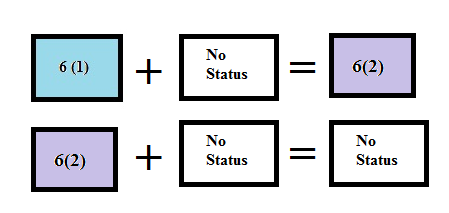
Look at this nautical chart again. Two generations of 'out-wedlock'. That is all it takes to completely lose Status. It does not thing if y'all heighten your grandchildren in your native culture. It does not thing if they speak your language and know your community. If y'all married someone without Status, and your grandchildren have a non-Condition parent, your grandchildren are non considered Indian any longer. Non legally.
To be honest, information technology is astonishing there are any Condition Indians left in this land.
Bill C-31, way to not set sexism!
One of the nearly criticised aspects of Bill C-31 was that information technology did not really reverse the sexism inherent in denying women Condition if they married a not-Status man.
Women who had their Indian Condition reinstated under Bill C-31 had 6(1) Condition, just their children had half-dozen(2) Status. That makes sense co-ordinate to the charts above, right?
The problem is that men who married non-Indian women actually passed on Indian Status to their previously not-Status wives. Thus the children of those unions have 6(i) condition.
Sharon McIvor, and Neb C-3: Gender Equity in Indian Registration Human action
Sharon McIvor launched an epic court battle to address the problems with Pecker C-31 and the Indian Act. In response a Nib was introduced to Parliament for Commencement Reading in March of 2010. The full title of this Beak is:
An Act to promote gender equity in Indian registration by responding to the Court of Appeal for British Columbia determination in McIvor v. Canada (Registrar of Indian and Northern Affairs)
Pecker C-3 was given Royal Assent on December 15, 2010 and came into force (became police) on January 31, 2011. A great many grandchildren of women who regained Status under Bill C-31 (but who passed on only 6(2) Condition to their children) can at present regain their 6(2) Status if they choose to.
In an unsurprising twist, this ways my female parent and her siblings are eligible for vi(2) Status. Many people are being faced with the aforementioned situation, and information technology is not an like shooting fish in a barrel choice to make. Identity politics are incredibly convoluted and mined with danger. For others who accept 'lived' Indian their whole lives, Status be damned, it can exist an important change…merely ultimately one that reinforces the so-chosen legitimacy of a colonial power deciding who is Indian and who is not.
By the way, 'Bill C-3 Indians' isn't very tricky…I wonder if we're going to beginning calling them 'McIvor Indians'? (Say it out loud 😀 )
Ring Membership
There are a number of sub-categories that use to Status Indians. One category is Band membership.
A Band is defined as a group of Indians for whom state has been set aside (a Reserve), or who have been declared a Band by the Governor General (no Reserve). A Band might take a number of reserves, but can also have no land reserved at all. Recollect of a Band as the people themselves.
Before Beak C-31, having Indian Status automatically gave yous Band membership. Pecker C-31 gave Bands the power to stay under the Indian Human activity Band membership rules (automatic membership with Status) or brand their ain rules regarding membership.
Thus you lot can have Status Indians who have no Band membership, merely as you can have non-Status Indians who do have Ring membership. Being a Condition Indian is no longer a guarantee that y'all will be a fellow member of a Band.
Beak C-3 Indians confront the same problems equally Bill C-31 Indians did. Having Status does not necessarily mean they volition be able to live on reserve or get Band Membership. The pros and cons of this are hotly debated, and then I'm going to back away slowly and not impact that, except to point out that there were and are no plans to make federal funding responsive to the influx of those with newly acquired Status under either Bill.
Reserves
Related to Band membership, some other sub-category is between reserve and non-reserve Indians. This does not refer to whether one actually lives on the reserve or non, only rather describes whether an Indian is affiliated with a reserve. These are people who take access to a reserve and the right to live in that location if they choose.
Even though no historical Treaties were signed in British Columbia, there are many reserves, while in the Northwest Territories which is covered by a numbered Treaty, at that place is simply one reserve (Hay River), and a number of communities chosen "settlements". I also pointed out to a higher place that you can have membership in a Ring that doesn't accept a reserve at all.
As in other situations, beingness a Status Indian does not guarantee you access to a reserve, and there are non-Status people who live on reserve likewise.
Treaty Indians
Another sub-category yous should know about has to do with whether or not someone is a Treaty Indian.
Treaties in this context refer to formal agreements between legal Indians or their ancestors and the Federal government, commonly involving country surrenders. The so called 'numbered Treaties' were signed between 1875 and 1921 and encompass nearly of western and northern Canada. British Columbia, with the exception of Vancouver Island is not covered by any historical Treaty.
Other Treaties were signed in eastern Canada, simply there are vast areas in the east that are still not covered past any Treaty. A number of modern (since 1976) Treaties accept been signed in BC, and in other areas of the country, and negotiations are nonetheless underway to create more Treaties. Some Treaties provided for reserves and others did not.
There are many non-Status Indians, particularly in eastern Canada, who consider themselves Treaty Indians. In the Prairies, "Treaty Indian" is ofttimes used interchangeably with "Condition Indian" although one is not always the aforementioned as the other.
Confused yet?
To sum up, Condition is held only by Indians who are defined as such under the Indian Act. Inuit and Métis do not have Condition, nor exercise not-Status Indians. In that location are many categories of Status Indians, merely these are legal terms only, and tell u.s.a. what specific rights a native person has under the legislation.
If a native person is not a Status Indian, this does not mean that he or she is not legally Ancient. More importantly, not having Status does non mean someone is not native. Native peoples will continue to be and flourish whether or not we are recognised legally and you tin bet on the fact that terms and definitions will continue to evolve.
Again: Please do non contact me for help applying for Status. I practice not accept expertise in the application process and cannot help you.

My Paternal Grandmother Was 100% Blackfoot Out Of Canada. How Do I Register?,
Source: https://apihtawikosisan.com/2011/12/got-status-indian-status-in-canada-sort-of-explained/
Posted by: murphyature1962.blogspot.com
0 Response to "My Paternal Grandmother Was 100% Blackfoot Out Of Canada. How Do I Register?"
Post a Comment